
Custom illustrations

Cover Illustration for the Million Veteran Program
2024 - Submitted for consideration to the journal Science, to accompany the manuscript "Diversity and scale: Genetic architecture of 2068 traits in the VA Million Veteran Program" by Verma et al.

Cover Illustration for the Vahedi Lab
2023 - Volume Control! - Submitted for consideration to the journal Immunity, to accompany the manuscript "Quantitative control of Ets1 dosage by a multi-enhancer hub promotes Th1 cell differentiation and protects from allergic inflammation" by Chandra et al.
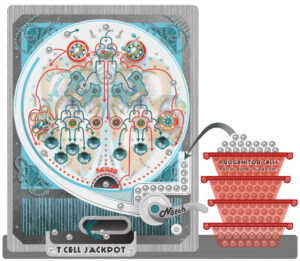
T Cell Pachinko Machine for the Vahedi Lab
2024 - For the Nature Immunology Review "The epigenetic landscape of fate decisions in T cells" by Jay, Pondevida, and Vahedi
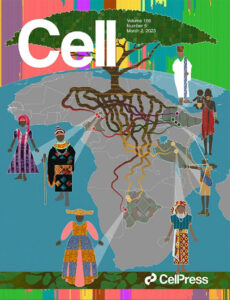
Cover Illustration for the Tishkoff Lab
2023 - Published on the cover of the journal Cell (Volume 186, Issue 5) to accompany the manuscript "Whole-genome sequencing reveals a complex African population demographic history and signatures of local adaptation" by Fan et al. - On the cover: In this issue, Fan et al. present high coverage whole-genome sequencing of 180 individuals from 12 indigenous African populations, reporting functional variants and providing insights on human evolutionary history. On the cover, diverse populations included in the study are illustrated by figures shown in their traditional dress. The roots of the tree terminate at dots indicating the locations where these populations reside, which is in four countries (Botswana, Cameroon, Ethiopia, and Tanzania). The color of the dots represents the four main languages spoken by these populations: Nigercongo (red), Khoesan (yellow), Afroasiatic (purple), and Nilosaharan (green). The vibrantly colored striped background is derived from the data in the paper and conveys the large amount of genomic diversity on the continent. Image credit: Stacie L. Bumgarner.

Cover Illustration for the Million Veteran Program
2024 - Created for consideration as cover art for the journal Science, to accompany the manuscript "Diversity and scale: Genetic architecture of 2068 traits in the VA Million Veteran Program" by Verma et al.

Cover Illustration for the Faryabi Lab
2020 - Submitted for consideration to the journal Nature Methods, to accompany the manuscript "TooManyCells identifies and visualizes relationships of single-cell clades" by Schwartz et al.

Cover Illustration for the Mainland Lab
2023 - The Cartography of Olfaction - Submitted for consideration to the journal Science, to accompany the manuscript
"A principal odor map unifies diverse tasks in olfactory perception" by Lee et al.

Cover Illustration for the Kaestner Lab
2022 - Published on the cover of the journal Cell Metabolism (Volume 34 Issue 9) to accompany the manuscript "3D chromatin maps of the human pancreas reveal lineage-specific regulatory architecture of T2D risk in cell metabolism" by Su et al. - On the cover: In this issue, Su et al. (pp. 1394–1409) establish the first cell-type-specific three-dimensional chromatin maps of the major cell types of the human pancreas. By integrating 3D contact maps with single-cell gene expression and chromatin accessibility maps, they establish that the connections between candidate causal variants affecting type 2 diabetes risk and their putative target effector genes are cell-type stratified and emphasize previously underappreciated roles for alpha and acinar cells in diabetes pathogenesis. The cover art uses three different flowers to represent the alpha cells, beta cells, and acinar cells that were profiled and visualizes the divergent 3D chromatin structures between the three cell types. Illustration by Stacie L. Bumgarner, PhD.
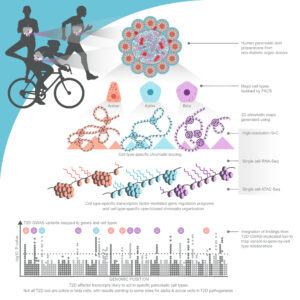
Graphical Abstract for the Kaestner Lab
2022 - Published in the journal Cell Metabolism to accompany the manuscript
"3D chromatin maps of the human pancreas reveal lineage-specific regulatory architecture of T2D risk in cell metabolism" by Su et al.

Cover Illustration for the Vahedi Lab
2018 - Published on the cover of the journal Immunity (Volume 48, Issue 2) to accompany the manuscript "Lineage-Determining Transcription Factor TCF-1 Initiates the Epigenetic Identity of T Cells" by Johnson et al. - On the cover: The transcription factor TCF-1 is essential in T cell development. It has been unclear, however, whether the mechanism by which TCF-1 controls T cell fate involves the specific transcriptional regulation of a small number of genes or whether this protein has a pervasive impact on the epigenomic regulation of T cells. In this issue of Immunity, Johnson et al. (243–257) show that TCF-1 controls T cell fate through genome-wide programming of the epigenetic identity of T cells. TCF-1 binds to previously occupied nucleosomes, generating de novo chromatin accessibility even at condensed chromatin regions, and induces the expression of T cell genes. The cover image illustrates TCF-1 as an “ice breaker ship” sailing ahead, “de-icing” condensed genomic regions, and leaving behind “accessible” regulatory elements. Illustration by Dr. Stacie Bumgarner.

Cover Illustration for the Faryabi Lab
2019 -Submitted for consideration to the journal Molecular Cell, to accompany the manuscript "Oncogenic Notch Promotes Long-Range Regulatory Interactions within Hyperconnected 3D Cliques" by Petrovic et al.

Cover Illustration for the Levy Lab
2023 - The Long Shadow of COVID - Submitted for consideration to journal Cell, to accompany the manuscript "Serotonin reduction in post-acute sequelae of viral infection" by Wong et al. - Their study found that “long covid” is associated with a reduction in serotonin level. They detected persistence of COVID-19 viral RNA in the gastrointestinal tract and infection-related inflammation that reduced serotonin levels, leading to a reduction in vagus nerve activity with resultant brain dysfunction and memory loss.

Cover Ilustration for The Type 2 Diabetes Global Genomics Initiative (T2D-GGI)
2024 - Submitted for consideration to the journal Science, to accompany the manuscript
"Multi-ancestry genome-wide study in >2.5 million individuals reveals heterogeneity in mechanistic pathways of type 2 diabetes and complications" by Suzuki et al.
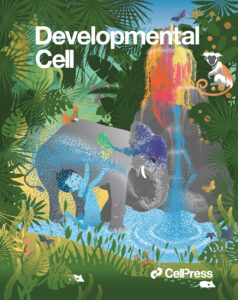
Cover Illustration for the Kamberov Lab
2023 - "How the Skin Got Its Sweat" - Submitted for consideration to the journal Developmental Cell, to accompany the manuscript "Sweat gland development requires an eccrine dermal niche and couples two epidermal programs" by Dingwall et al. The dots that make up the elephant's head and that cascade down the rocks are derived from actual data presented in the paper: UMAP projection of 45,370 nuclei from merged control and test datasets analyzed in the study, colored by cluster identity and split by condition.
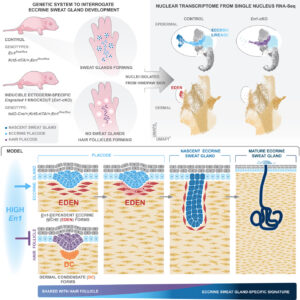
Graphical Abstract for the Kamberov Lab
2023 - Published in 2024 the journal Developmental Cell to accompany the manuscript "Sweat gland development requires an eccrine dermal niche and couples two epidermal programs" by Dingwall et al.

Cover Illustration for the Vahedi Lab
2022 - Submitted for consideration to the journal Nature Immunology, to accompany the manuscript "TCF-1 promotes chromatin interactions across topologically associating domains in T cell progenitors" by Wang et al.

Cover Art for the Voight Lab
2017 - Published on the cover of the Journal Nature Genetics (Volume 49 Number 6) to accompany the manuscript "The Nephila clavipes genome highlights the diversity of spider silk genes and their complex expression" by Babb et al.

Cover Illustration for Professors Shefali Verma, Marylyn Ritchie, & Joan O’brien of the University of Pennsylvania
2024 - Submitted for consideration to the journal Cell, to accompany the manuscript
"A multi-cohort genome-wide association study in african ancestry individuals reveals novel risk loci for primary open-angle glaucoma" - In their paper, Verma et al. addresses the striking lack of diversity in genetics research by elucidating the genetics of glaucoma in individuals of African ancestry. The mosaic eye in this submitted cover illustration is created from 1200 smaller eyes, each representing 5000 individuals as a visual illustration of the estimated 6 million individuals who were bilaterally blinded by primary open-angle glaucoma (POAG) in 2020. The blurriness at the periphery of the eye represents the loss of peripheral vision caused by POAG. The African continent appears in the pupil of the eye mosaic. The mosaic shows how individual contributions by thousands of subjects can reveal an entirely new image—or in this case, a deeper understanding of this blinding disease in the most affected population.

Cover Illustration for Professors Shefali Verma, Marylyn Ritchie, & Joan O’brien of the University of Pennsylvania
2024 - Submitted for consideration to the journal Cell, to accompany the manuscript
2024 - Submitted for consideration to the journal Cell, to accompany the manuscript
"A multi-cohort genome-wide association study in african ancestry individuals reveals novel risk loci for primary open-angle glaucoma" - In their paper, Verma et al. addresses the striking lack of diversity in genetics research by elucidating the genetics of glaucoma in individuals of African ancestry. This cover illustration includes a mosaic of fundus photos of the optic nerve from subjects enrolled in the Primary Open-Angle African American Glaucoma Genetics (POAAGG) study at the Center for Genetics of Complex Disease at the University of Pennsylvania. These photos form a larger image of an eye and double-helix DNA strand, representing the key components of this study. The mosaic shows how individual contributions by thousands of subjects can reveal an entirely new image—or in this case, a deeper understanding of this blinding disease in the most affected population.

Cover Illustration for Professors Shefali Verma, Marylyn Ritchie, & Joan O’brien of the University of Pennsylvania
2024 - Submitted for consideration to the journal Cell, to accompany the manuscript
"A multi-cohort genome-wide association study in african ancestry individuals reveals novel risk loci for primary open-angle glaucoma" - In their paper, Verma et al. addresses the striking lack of diversity in genetics research by elucidating the genetics of glaucoma in individuals of African ancestry. This cover illustration includes a mosaic of fundus photos of the optic nerve from subjects enrolled in the Primary Open-Angle African American Glaucoma Genetics (POAAGG) study at the Center for Genetics of Complex Disease at the University of Pennsylvania. These photos form a larger image of Africa, with an eye and double-helix DNA strand, representing the key components of this study. The mosaic shows how individual contributions by thousands of subjects can reveal an entirely new image—or in this case, a deeper understanding of this blinding disease in the most affected population.

Cover Design for the Shalem Lab
2025 - Submitted for consideration to the journal Molecular Cell, to accompany the manuscript "Pooled tagging and hydrophobic targeting of endogenous proteins for unbiased mapping
of unfolded protein responses" by Sansbury et al. - SPOTLITES refers to Scalable POoled Targeting with a LIgandable Tag at Endogenous Sites, a research methodology developed by the Shalem lab. This technique involves tagging endogenous proteins with a HaloTag, which can bind to various small molecules, enabling high-throughput imaging and perturbation to study cellular responses to localized unfolded protein stress in an unbiased manner.
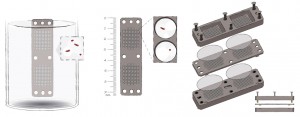
Uncultivable Microbes: the iChip
2009 - Scientific illustration for Professor Slava Epstein of Northeastern University (Boston MA)
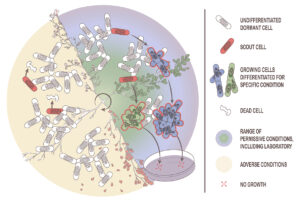
New Scout Model – for the Epstein Lab
2015 - Custom scientific illustration for Professor Slava Epstein of Northeastern University (Boston MA).
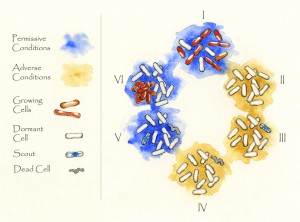
The Scout Model – Dormancy Case
2008 - Custom scientific illustration for Professor Slava Epstein of Northeastern University (Boston MA) - Watercolor & pencil on paper, with text added digitally
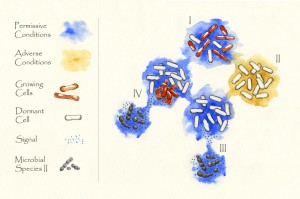
The Scout Model
2008 - Custom scientific illustration for Professor Slava Epstein of Northeastern University (Boston MA) - Watercolor & pencil on paper, with text added digitally

The Chamber Trap
2009 - Custom scientific illustration for Professor Slava Epstein of Northeastern University (Boston MA)

Menu Elements for Aksum
2014 - Custom graphic designs for the menus at Aksum Mediterranean Kitchen in Philadelphia, PA
Menu Elements for Aksum
2014 - Custom graphic designs for the menus at Aksum Mediterranean Kitchen in Philadelphia, PA

Menu Elements for Aksum
2014 - Custom graphic designs for the menus at Aksum Mediterranean Kitchen in Philadelphia, PA

Postcard Design for Lil Pop Shop
2014 - Custom graphic design for
Lil’ Pop Shop (Philadelphia PA)

Postcard Design for Lil Pop Shop
2014 - Custom graphic design for
Lil’ Pop Shop (Philadelphia PA)

Broad Institute G-nomics Puzzle Design
2010 - Custom Illustration for the Broad Institute in Cambridge MA

Poster Design for Allen Campaign
2014 - Custom graphic designs for Algernong Allen's campaign for State Representative in Philadelphia, PA

Postcard Design for Allen Campaign
2014 - Custom graphic designs for Algernong Allen's campaign for State Representative in Philadelphia, PA

Postcard Design for Allen Campaign
2014 - Custom graphic designs for Algernong Allen's campaign for State Representative in Philadelphia, PA

Logo Design for Allen Campaign
2014 - Custom graphic designs for Algernong Allen's campaign for State Representative in Philadelphia, PA
© 2026 Stacie Leigh Bumgarner and Red Windmill Studio. All Rights Reserved.